Contentious Governance: Sub-National Governments, Activists and Contested National Policies
Book presentation by dr. Imrat Verhoeven
What can we learn about policy conflicts if we look beyond the traditional dichotomy between citizens and governments? In his new book Contentious Governance: Sub-National Governments, Activists and Contested National Policies, UvA public policy expert Imrat Verhoeven argues that local authorities and activists often work together to oppose national policies. This event about the book is moderated by Martien Kuitenbrouwer, and features Imrat Verhoeven, Tamara Metze and Saskia Tempelman.
Event details from: Contentious Governance: Sub-National Governments, Activists and Contested National Policies
- Date
- 2 December 2026
- Time
- 20:00 – 21:30
- Location
- SPUI25
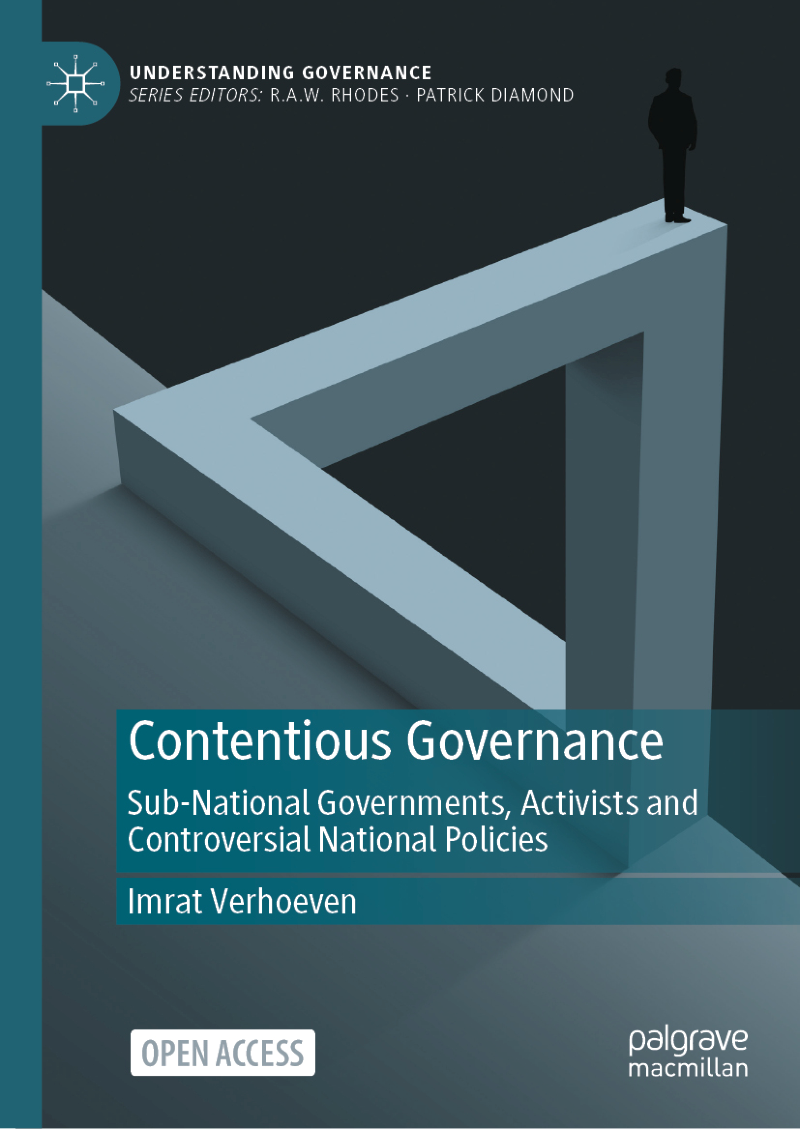
Dr. Verhoeven's latest book examines the subject of ‘contentious governance’, a situation in which lower-level governments collaborate with activists to contest policies implemented by national governmental actors and their business allies. Drawing from three Dutch case studies on contested natural gas-production, nearshore windfarms, and Carbon Capture and Storage it introduces the concept and relevance of contentious governance, before assessing how it works in action.
The book demonstrates that the processes of contentious governance are inherently political and riddled with power struggles, as those involved vie for the interpretation of public interest. As instances of contentious governance become increasingly common, it also proposes a framework through which to better understand its complexities. In doing so, it provides fresh perspectives on numerous classical issues, including the political nature of policy, power dynamics, governance processes, government-citizen relations, and policy conflicts.
About the speakers
Imrat Verhoeven is Associate professor of Public Policy at the Political Science department of the University of Amsterdam and an endowed lector at the Amsterdam University of Applied Sciences. His work focuses on policy conflicts, the role of emotions in policy processes and on democratic professionalism.
Martien Kuitenbrouwer has over 30 years’ experience in complex collaboration issues in the public sector. She is a co-founder of the Public Mediation consultancy and also works as a lecturer and researcher in the Department of Political Science at the University of Amsterdam.
Tamara Metze is full professor in Public Administration at Delft University of Technology. In her research on sustainability transitions there is a special focus on the role of boundary objects, (visual) framing, conflict, and on knowledge cocreation through research by design and scenario development.
Saskia Tempelman has been working in the field of polarisation and radicalisation for over 25 years. She currently heads the Social Unrest Support Network at the Ministry of the Interior and Kingdom Relations.