From smooth cities to porous urban horizons - with René Boer
Amsterdam as a Lab? An interview series on producing knowledge on and from the city
5 November 2026
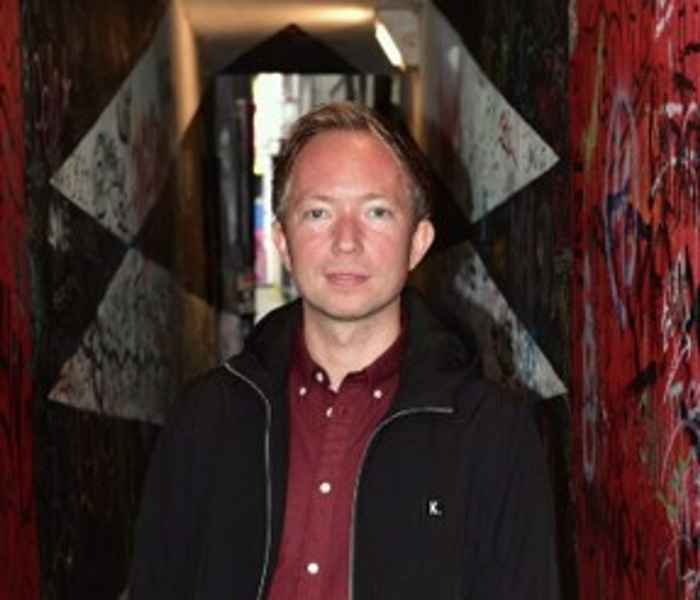
Somewhere in the midst of this transition from critic to “transformation facilitator”, his book Smooth City: Against Urban Perfection, Towards Collective Alternatives (Valiz, 2023) was published. In it, he brings together observations from different cities to analyse a new “urban condition” that he suggests is emerging worldwide. The book thus represents one of the recent attempts within urban studies to sketch a global picture of contemporary cities. René describes a situation in which all urban layers and complexity are flattened by a growing obsession with perfection and optimisation. This is visible not only aesthetically, but also in the ways certain behaviours and bodies are expected and accepted while others are not. White, heteronormative, middle-class bodies move relatively unhindered through the “smooth city”, while there is less room for non-normative bodies to help shape it. This also reduces opportunities for unexpected encounters or productive conflict between different users and ways of engaging with urban space.
Our conversation with René explores Amsterdam as his everyday urban environment, a place in which he is deeply rooted and to which he is actively committed, but also as a starting point for thinking about broader urban transformations. He reflects on Amsterdam’s shift from a celebrated model city to an object of criticism, and on the role urban knowledge production has played in this. We also discuss the role of other cities, such as Cairo, with which he continually compares Amsterdam and which form an important part of his broader theoretical thinking. In doing so, he considers both the possibilities and the risks of making more universal claims about urban change on the basis of situated observations and theories.
Much of René’s work stems from his relationship with De Wallen (the historic city centre and Red-Light District). We therefore meet on the Zeedijk, near where he lives, and walk through De Wallen to the Oude Kerk, where he previously shared a workspace with Failed Architecture. We settle at a table in an upstairs room of the church café, looking out over De Wallen through the window during the interview.
René: I’m really rooted here. I could tell you something about every stone. Almost every street corner holds some experience I’ve had [laughs]. So, in that sense, Amsterdam is completely bound up with who I am.
I’ve been living in De Wallen for ten years now. My parents met in the other “mini Red-Light District” around the Spuistraat, so I have a kind of connection to that area too. And for a long time, we had our little Failed Architecture office here in the Oude Kerk. Before that, I’d spent several years living in Cairo, Egypt. When I came back to Amsterdam, I thought: oh wow, everything that appeals to me about Cairo – the intensity, the layers, the multiplicity, the complexity, and the stubborn particularities of the place – I found right here in De Wallen. So this was actually where I felt most at home again. And then I made an effort to see if I could find somewhere to live here. So yes, I’ve lived here ever since.
Lies: Could you see De Wallen as your “lab”, then, from which most of your work emerges?
René: Well, given the way we’re working with De Wallen now… And we’ve been involved with it in so many ways for so long. For example, we created an enormous installation on the Oude Kerk, but also lots of projects inside the church and around the neighbourhood, and some extraordinary “swarm sessions” during the pandemic involving hundreds of people – COVID-safe, by the way. We’ve done thousands of different things, from wild parties to our “Opwallen” project…incredible.
[Loom has identified 38 “gaps” or “missing teeth” between buildings in De Wallen and is now working with owners, the municipality and investors to fill them with affordable, sustainable new buildings designed by young architects: “Rather than simply historicising again, pretending everything is 400 years old, we also want to show the aesthetics of our own time and let them rub up against what’s already there.”]
So yes, in that sense, I think it makes sense to see it as a lab. But I’ve never called it that myself; it’s almost a given that I’m simply here, that this is where I wake up. And “lab” also suggests that you have control, which isn’t how it feels at all. Mostly, it feels as though lots of other people have a great deal of control over Amsterdam.
But yes, De Wallen certainly plays a very important role in my work: thinking about “the city” from here.
Lies: Together with your perspective from Cairo, then?
René: Yes, definitely.
Lies: Have you lived anywhere else?
René: Yes, I did my master’s in Urban Studies in London. And I lived in Ramallah, Palestine, for quite a while, taking a break from my bachelor’s in urban planning. There, I also spent a lot of time working on the spatial aspects of the occupation of Palestine. For example, I conducted research for and worked with NGOs dealing with the often sudden and unannounced demolition of Palestinian homes. And I completed my bachelor’s in Barceloneta, a neighbourhood in Barcelona that has been struggling with touristification and overtourism for quite some time.
Lies: And how would you say all those different perspectives feed into your work?
René: They all offer new insights into how cities can function differently. In Amsterdam, you often get the feeling that everything has to be optimised, everything neatly renovated and manicured, as though that were the only possible aesthetic. Sometimes I also feel that people don’t look very broadly at what cities in other parts of the world can be like. That’s not to romanticise chaos elsewhere, but there are simply all sorts of ways in which people take over public space and buildings from the bottom up that can produce a great deal of value.
Another very important influence on me is my background in the squatting movement. I also wrote a book about that: Architecture of Appropriation [edited with Marina Otero Verzier, Katía Truijen; Het Nieuwe Instituut, 2019]. It’s about architecture that emerged within the squatting movement – and still does, by the way, because the movement is, of course, still active in various ways. It’s about the very direct energy that emerges when people gain fairly immediate control over a building and put their heart and soul into making something special out of it. That produces a very different kind of architecture from something designed in advance that people then have to fill in afterwards.
Lies: We can go straight into squatting in more detail, but first I wanted to ask whether you also actively try to exchange knowledge between those other places and Amsterdam – things you think Amsterdam could learn from?
René: Yes, definitely. With Loom, for example, we have a really lovely project called “Grounded Urban Practices”. It initially involved an exchange between Amsterdam, Rotterdam and Cairo. And it started from a reflection on the financial crisis. I think 80% of architects here lost their jobs at the time, all the projects were stopped – total mayhem. And around the same time, of course, there were all sorts of major political upheavals around the world, including the Arab revolutions. In cities like Cairo, but also elsewhere in the Arab world, that was a kind of incentive for people to work on the city in a completely different way. Suddenly, there was a sort of political vacuum. People simply started building things on their own initiative – new schools, new cinemas, cultural centres – because nobody objected. And of course, I don’t want to simply romanticise that, but it unleashed an enormous amount of energy. At the same time, here in the Netherlands, architects also began experimenting because they no longer had any work. So what we’re looking at through this project is how an entire generation began doing things radically differently in a very short space of time. The architect was essentially transformed into a kind of… grounded spatial practitioner, tactical interventionist – whatever term you want to use. And we’re trying to connect those experiences across the different cities. We’re also trying to connect this with a new generation of urbanists, planners and architects. What can they learn from the ways people started these kinds of new urban practices fifteen years ago?
Lies: Let’s return to Amsterdam for a moment. In the late 1990s, a predecessor of CUS [the Centre for Metropolitan Research] published Understanding Amsterdam [Essays on economic vitality, city life & urban form, edited by Léon Deben, Willem Heinemeijer, and Dick van der Vaart published in 1993, then reedited and expanded in 2000, by Het Spinhuis], which presented Amsterdam as the exemplary tolerant, cosmopolitan and socially inclusive global city.
At the same time, the book already contained some observations about developments we would now describe as smoothification or neoliberalisation, without using those terms. Yet optimism prevailed: Amsterdam had overcome its “decline” of the 1980s, had regained an important position in the global economy, and was attracting middle-class families again. As someone who grew up here and was active in the squatting movement, how do you look back on that development?
René: Of course, I was still very young in the 1990s, but I do think you pick up on those things as a child. I mainly have a few memories – for example, cycling through the city and seeing half the buildings propped up with tree trunks, because otherwise they would simply collapse. But it’s only once you’re an adult – and by that point, smoothification had also gathered pace – that you feel: hey, the city is slipping through my fingers! Everything I find beautiful and important keeps disappearing.
And because of that, I’m also in a kind of permanent state of mourning for the city. I genuinely feel that I’m still losing something every day. It affects me deeply; sometimes it really makes me choke up. The city you grew up in, that you embraced, then evaporates before your eyes, so to speak. And I also experienced it as profoundly violent when the kinds of places we created – for example, for queer subculture, where a new generation of queer people came together to build communities – were destroyed by the authorities with considerable force. I really experienced that as deeply violent. And that was also one of the reasons I went away to Cairo for a longer period, for example, because, on several occasions, extraordinary places – places we had created collectively from the bottom up, which harmed no one and were nothing but an incredible addition to the city – were simply forcibly dismantled.
Nik: What kinds of places were they?
René: Well, Schijnheilig, for example: that was a series of squats, the last of which lasted quite a long time, just behind the Leidseplein. An important queer festival also emerged there: Queeristan. This was at a time when the word “queer” simply didn’t exist in Amsterdam yet – you only had LGBT or LGB. Queer theory existed only in America. Of course, it was already a lived practice here, but in America it had become a theory, and it was only around that time, in 2010, that the two came together here. But that place was completely smashed to pieces. And now there’s some commercial “business school” there.
When you put your energy into this kind of powerful undercurrent and subculture in the city, and it keeps getting smashed to pieces, at some point you hit a kind of bottleneck: how long do you keep going? So there have been several moments when I thought: I need to carry on with this somewhere completely different.
Cairo thus became, for me, a kind of answer to everything that is going wrong in Amsterdam. But I also know that it is not an entirely honest answer. When I am in Cairo, I am completely swept up by its layers, its intensity, its multiplicity, and the multipolarity of everything. And then I get a kind of high that lasts for months. But I am absolutely aware that, if you try to get things done there, it is much more difficult than it is here, with a completely unreliable bureaucracy and a completely militarised government that is building the most appalling new capital, with motorways cutting straight through historic neighbourhoods as though it were the 1950s. And I absolutely do not want to romanticise that. So it is mainly an outsider’s perspective. But I work with many more people on the ground there who are doing really exciting things, and who actually manage to get things done despite that complex situation.
To return briefly to the role of [a predecessor of] the Centre for Urban Studies like that, and the books they published: I do think they were on the wrong side of history. I mean, it was not as though nobody knew about this in the 1990s, was it? There were already people who realised that things were not going well. There were all kinds of protests against the transformation of city centres into commercial business districts, against large commercial property developments. I can understand, to some extent, why people found it interesting that there was a kind of new energy in the city: people had been leaving in droves, and suddenly there was renewed interest in doing something with the city. But there were already plenty of dissenting voices and criticisms at the time, and it is unfortunate that precisely those who were ‘at the forefront’ of thinking about the city did not embrace them more. There was such an incredible amount of space in the city then, so many possibilities and opportunities: vacant buildings, everything was incredibly cheap... That would have been the moment to secure the city’s social foundations. And architects, planners, but also the political class of the time, really missed a huge opportunity – they really sold their souls – and that continued for a long time. You had, for example, the ‘I amsterdam’ campaign, an initiative by the city to promote itself internationally, which the previous municipal administration finally ended. But that simply continued until after COVID. Meanwhile, the city had already been completely sold off. Even when that campaign was launched in 2005, there was already a great deal of criticism and protest. So I think it is also important to look closely at exactly who was responsible, and who only realised far too late that things were heading in the wrong direction.
Lies: Because you also notice in your book that many of the thinkers you cite had already begun to describe these kinds of changes critically in the 1990s.
René: Yes, exactly!
Lies: Whereas the predecessor to CUS worked with visiting scholars [such as Susan Fainstein, Edward Soja, Manuel Castells, among others]. So they did not know Amsterdam itself very well but looked at the city from the outside – which I think did influence their positive outlook. Moreover, their aim was not so much to produce knowledge that was directly relevant to Amsterdam, but to make broader, universal claims about globalisation and cities. And yes, if you were used to a North American context at that point – many of those researchers came from the US – then Amsterdam could come across as a positive example of globalisation.
René: Yes, didn’t Justus Uitermark (2009) also write a well-known response to Susan Fainstein, who was very positive about Amsterdam? And rightly so, but I think people like that often did not realise where things were heading. If you have never been to Amsterdam before and you step outside here now (points out of the window), that is, of course, an incredible experience too. But yes, until you realise...
Lies: Yes, so their knowledge production was not innocent. That book was, in a sense, also part of Amsterdam’s attempt to promote itself as a ‘global city’ in an increasingly competitive economy, in which cities had fewer and fewer public resources and became more dependent on attracting international flows of money. And academia may have gone along with that a little too –
René: – much, yes. But what you are saying is indeed true: there were already academics in the early 1990s who challenged that. And I think that was the moment when ‘smoothification’ really went into a kind of overdrive. Because you had the initial driving force of neoliberalisation, but also of digitalisation, which was getting under way at that point – suddenly you had Photoshop and Premiere; you could make everything look better. And of course there was also globalisation, in the sense of the end of the Soviet Union, but also all those big companies suddenly being visible everywhere. So I think a kind of ‘all-out push’ emerged in the late 1980s and early 1990s. So yes, between ’92 and ’95, a great many people, including Rem Koolhaas and Mark Augé, wrote all those texts: they sensed what was happening.
Lies: Yes, I also wanted to ask you which thinkers influenced your book, and how you position yourself in relation to that line of thought. What strikes us is that your book actually makes quite a universal claim: that ‘smoothification’ is a broader process that is becoming increasingly prevalent across the world, which is also what makes it so problematic for you. At the same time, many of the thinkers whose work you build on start more from European or American contexts – and, to some extent, so do you: you mainly start from observations in Amsterdam, Cairo, and London. So perhaps two questions: whose ideas do you build on, and how do you then try to generalise that theory or transfer it to other contexts?
René: Well, I find it interesting that people were already thinking about this in the 1990s. But most of those texts remain quite particular. I think that was because it was a fairly new phenomenon at the time, so people saw different forms of smoothness in different places and had quite particular descriptions of them. For example, Koolhaas’s ‘Junkspace’ (2002) is a very specific kind of description of what residual space in the Smooth City looks like, or the ‘Generic City’ (Koolhaas, 1995). So that was very much at the beginning; now, of course, we are thirty years on. And I think the sum of all those kinds of places has taken on a much more totalitarian character. And I had the feeling that nobody had really tried to make sense of that yet. I also noticed that a great many people always used the term gentrification for everything – which is a very important term, but I also felt it was being used imprecisely. Anything people disliked was always called gentrification, rather than making precise use of the socio-geographical theory behind it, so to speak. That is why I thought it was important to introduce a new term. And yes, it does involve a bit of sweeping generalisation; there is also something deliberately provocative about the term. Yes, it is polemical. And yes, of course there are all kinds of nuances in practice. The Smooth City never manifests itself in its most extreme form; it is always a spectrum. It is also a spectrum within yourself. We all have forms of smoothification in our own lives that we may or may not embrace. But ultimately, the book also tries to raise those questions. Precisely by using a polemical approach to prise the discussion open.
Lies: Yes, I do sometimes feel that, if ‘gentrification’ used to be used for everything, ‘smooth’ might now be becoming something similar. That may be more my personal issue with it – I do not actually know whether it is a problem, but you really can apply it to everything. It almost becomes a totalising category like ‘neoliberalisation’ – the difference between the two is not always entirely clear to us, either. Where I do see a difference is precisely in your rich descriptions of the aesthetic and phenomenological: what it looks like, how it feels, and how you recognise it in the city.
René: That is indeed an interesting aspect. When you talk about neoliberalisation, you are talking about very abstract economic processes. And I think the ‘Smooth’ is very much about material observation: everything is made of glass, everything has been carefully designed in advance, everything has been softened, all the dirt is gone. It is very much about ‘the endpoint’: the material, visual, aesthetic endpoint. And I also see an analysis of the problem there: the fact that everything has been so perfected. I think neoliberalisation is, of course, a problem in itself – with all the commercialisation it brings, and the gentrification it brings. Some people have to leave their neighbourhoods, which is obviously a problem. Having no privacy anymore is a problem. But quite apart from that, I think the fact that everything has been so flattened out is also a problem, alongside gentrification. The fact that, if you do not look and behave in accordance with all those optimised concepts, that too becomes a problem.
So it is not that I thought: I will just come up with my own concept that secretly means the same thing as neoliberalisation. I was trying to address the question: what does it mean that it is now inevitable that everything is caught up in that same kind of smoothness?
Lies: Was it also a conscious choice, then, to address a particular audience? With this very broad kind of concept, which you can apply to so many things, and in a book that is not an academic publication?
René: I think it is a subject I had been engaging with unconsciously for a very long time, in different ways – the qualities of shared life, of flourishing, of the unexpected, and the problems associated with these kinds of smoothing and control processes – and only later did I find a term for it. And I am used to working much more in direct dialogue with people. For example, at Failed Architecture we were constantly putting ideas out there, and that always involved a kind of debate and discussion – very immediate. But also in squatting, for example: the moment you occupied a building, there was immediately a conversation about it. People were angry, people were enthusiastic, people had opinions, people started investigating. And yes, that was actually my reason for staying away from academia as well. Of course, it absolutely has value, but I am personally more interested in that directness and immediacy.
Lies: Yes, of course there is also enormous value in naming something that many people and movements are already working on, and that many people probably sense intuitively. You give it a word, which can also be a tool for people and movements to take further. At the same time, you bring together a great many complex theories and thinkers in one book with a fairly simple message. I think that might cause frustration from an academic perspective.
René: (laughs) Yes, yes. But I really did take those theories seriously. Many of them also have an academic background; I value that and take it very seriously too.
Lies: And you make them accessible.
René: Yes, yes, exactly. But research in academia naturally has to meet all kinds of requirements: it has to be testable, traceable, peer-reviewed. As a result, researchers often find it difficult to zoom back out and work with one broad brushstroke, so to speak. That is not something people are readily inclined to do, and I do not think it is really valued within academia either.
Nik: Because we were wondering: were you ever taught by Jennifer Robinson in London? Are you familiar with her?
René: Yes.
Nik: Because she is very influential now in the Urban Studies teaching we receive at the UvA. And she fundamentally challenges the very ambition to extend theories beyond a particular area. That is quite an important epistemological foundation for us: you start from places, and you can then make comparisons with other places, but it is best to stick to ‘modest’ or ‘provisional’, ‘mid-level’ theories rather than universal claims (Robinson, 2015; Peck, 2015).
René: Ah, yes. And of course there are good reasons for that. But I think you can sometimes miss larger patterns that way too.
But it is also interesting that I have never received a response from that Urban Studies department in London. Because, I mean, the book I wrote – for what it is worth – is stocked at Tate Modern and all the major bookshops in London. But it is not as though the university where I studied has invited me back. Whereas I would actually welcome some critical reflection from academia. Something like: ‘This is far too sweeping’, ‘You cannot make that claim’, ‘Perhaps that is not how things are at all’. But yes, nobody has really taken the trouble to write a critique.
Lies: I am curious about how you would respond to criticism of the universality of your ‘Smooth City’ claim. Because you start from observations in three cities and use theories that were also mainly developed in Euro-American contexts, yet ‘smoothification’ is supposed to be happening everywhere. How do you substantiate that?
René: Yes, that is obviously a very valid point. Um, yes, I think it does, in a way, come out of the broad-brush approach I took. And I think it is also based on personal observations in many places I have been to where you see this. But I developed much of my thinking during COVID. And I had planned, for example, to visit Asian smooth cities in particular and learn more from them. Singapore or Dubai, for instance, are also paradigmatic smooth cities in a certain way. But unfortunately that did not happen. I have travelled a great deal and I really enjoy it, but I also try to limit how often I travel around the world. Still, I think it is more about sketching out a kind of horizon of what is actually happening, and holding up a kind of mirror for people, rather than having conclusively proved that this really is happening everywhere. Because yes, of course, I have not been everywhere either. And the interesting thing is that you can always come up with a counterexample. So yes, if I say ‘Amsterdam, smooth city’, people say, ‘Well, but it has actually been quite dirty lately.’ Or ‘London, smooth city’: ‘Well, everything is standing empty because the bankers are leaving it all vacant. So actually it is just like Amsterdam in the 1980s.’ And I think that is ultimately not the point either. That is also why there are no photographs of cities in the book. Instead, those collages (see below) sketch out the idea that, in every development – primarily in Western cities, and more generally in globalised cities – there is a kind of horizon towards which every development moves, and almost never in the other direction.
Lies: And is that because those desires for the ‘smooth’ are so globalised? Or because they are so closely linked to global capital too?
René: Yes, absolutely. And also simply because the city is an attractive place worldwide. I mean, people used to move to Purmerend, and now you move to Dubai if you get the chance. That is a kind of ultimate dream for ‘tech bros’ and influencers. So the city, and the smooth city specifically, is becoming more popular again. And then you also have the driving force of global capital, and the digitalisation of everything, which is of course happening everywhere. And I think that is a major difference from the past. There were forms of perfecting things then too, of course, but they were often planning paradigms. Haussmannisation, for example, was, I think, a very specific and localised idea. But I think those major drivers – digitalisation combined with the popularity of the city and neoliberalisation – are simply the constant driving forces behind smoothness. And I think you can certainly say that this is universal. I do not really need to go to Latin America again to see whether or not there is digitalisation there, because it is simply happening there too.
Lies: Yes, and framed that way, the claim holds up. I would like to talk briefly about ‘porous urbanity’, the alternative you set against the ‘smooth city’. What resonated with me, or confronted me, in the book was noticing how deeply I have internalised that smoothness, how much comfort I derive from it, partly because I inhabit a particular kind of body that moves relatively easily through smooth environments. As a result, I notice that alternative ways of engaging with or inhabiting the city can actually feel uncomfortable or disorienting. But I agree with you that an important alternative lies there. So I wondered whether you could say something about the role of disorientation – you refer extensively to Sara Ahmed in that context – and perhaps also conflict, in developing alternatives beyond the ‘smooth city’?
René: Yes, that is really interesting. Because, of course, all of that is within us, and within me too. It is also my own self-help book, of course.
Nik: That is a really nice quote! (everyone laughs)
René: Yes, yes. I mean, if I arrive somewhere abroad to give a talk, and I press one button and an Uber pulls up... am I going to deliberately avoid doing that at that moment? No. I have already booked a hotel through another app; I know exactly where I am going and how everything works; my mobile data plan is already activated. So you go along with it yourself too. I also have an app for listening to music, and my MP3 collection is sitting somewhere on a hard drive. That was such an autonomous, self-organised way of managing, listening to, and sharing music. Now all I have is a subscription to an app. I am part of it myself too.
And then I think: it is not so much about feeling guilty, or some kind of misplaced notion of privilege. I do think it is absolutely important to point the finger at people who are actively involved in creating smooth structures, in building the smooth city – such as the people working on the Erotic Centre here to get sex workers out of the Red-Light District. Those are such concrete forms of that smoothification. I think we need to be very aware that all of this is also within us, but there is not much point in feeling terribly guilty about it.
It can, however, be very interesting to explore how we can seek out more porosity together, and what forms of disruption might get us there. So if people start a really exciting decentralised music-sharing network, for example, it is simply incredibly important to be part of it, and to maintain and cultivate it. That app could disappear tomorrow, and then there is no music culture; everything is gone. You have absolutely no control over it; it is completely abstract. Or they increase the prices fivefold, and then half the people can no longer afford it. So it is about actively seeking out forms of porosity in your own life and building them together.
And of course, you cannot blame people for renting some student room in one of those cynical box-like buildings for twelve hundred euros and then leading that completely boxed-in life. Sometimes you simply cannot do otherwise, because there is little choice. So I would not want to criticise that or point an accusing finger at people for living a smooth life – they have an app that lets them control everything, everything has already been thought through, exactly where everything should go, and so on. Of course, it is appalling, but that is how things are. But if people get together and break into a building just around the corner here by the Rokin to create a new space for contemporary music, then I think: ‘Wow, that is so incredibly exciting!’ Take matters into your own hands to live differently, to create a form of friction and refusal and disruption. Then you immediately have porosity. You can simply walk over and become part of that community; you can live there. It is a kind of invitation to the city. So yes, what I am especially interested in is: how can we move forward together?
But I also have to admit – yes, at what moments do I actually still do that in my own life? I have taken part in and been involved in a great many things like that. But yes, as time goes by... I mean, I also find it convenient to have a stable place to live. And yes, I will renovate it when I have some savings. But what are productive moments for seeking out, for leaving room for, what is different?
Lies: Yes, and for accepting the discomfort that might initially come with that?
René: Yes, yes, but when do you actually do that? Actively allow yourself to become disoriented? Who has time for that, and when? You have to graduate. You have all these assignments to complete. I just think it would be very interesting to explore together whether you could create a different kind of culture around that. Right now, there is very little culture of encouraging one another to do it. A nightlife culture, for example, in which people really embrace chaos rather than neatly dancing within the lines, rather than going to a club where everything has already been planned and you know exactly what time you will come out again and in what state. How can you create a nightlife culture in which the unexpected is genuinely possible – how can you make that together? That is richness in the city. That is cultural production and cultural renewal. There you have a rich and fulfilled life, and – [realises he is getting carried away by his enthusiasm] anyway. [Laughs]
Nik: Is that how you write too?
René: Exactly! (laughs) Well, what is interesting is that, afterwards, I realised... Porosity only appears in the book as a single final chapter; it is more of a horizon, again. Partly because I particularly want to avoid people saying to me: well, you are romanticising danger and misery. I want to show that I very much hope for a different kind of world. But I do feel that this has not been clear enough to people. So I am considering writing a very romantic utopia about how I think porosity could exist, and in which domains.
Lies: Yes, that sounds nice. Nobody writes good utopias anymore.
René: Yes, that is true too. Nobody dares to write a utopia anymore.
Lies: That says something about our times too, of course.
René: Yes, of course.
Lies: Then, briefly, about the plot(ting) research group you were part of. Because that is a less romantic form of porosity: a porosity that arises from people having to survive, because their existence cannot be ‘smooth’ in the first place – which makes them inherently disruptive. The ‘plot’ is a concept developed by Sylvia Wynter (1971) that starts from the history of the plantation, whose violent and extractivist logic, she argues, lives on in contemporary cities. Plots were pieces of land that enslaved people were allowed to use to grow their own food. They were not free spaces, but they were spaces where other social relations and forms of life could emerge within the logic of the plantation. We are curious about what you discussed during this project and how you applied this concept to the contemporary city. How can the plot, as a metaphor and a practice, offer an alternative to today’s dominant urban logic?
René: I find it a very interesting term, and I think it resonates strongly. In the sense that you have a larger extractivist system, and within it there is always a kind of counter-space or countermovement. I think that is a very, very interesting historical observation. I absolutely agree that you can recognise how it continues to operate today. For example, if you have some five-star hotel where people are working day and night. Of course, you cannot equate that directly with slavery, but people are being worked to the bone there too. Perhaps they have a smoking area where they can find a brief moment for themselves, where they might even share union organising tactics. To my mind, that is a kind of comparable version of plotting. You could actually also see squatters as a form of plotting, and the city as a kind of extractivist whole within which they carve out their own space. But in a way, it does feel as though the term is then limited to that. Various people have thought about this, of course, but that is something I struggle with: ultimately, I am interested in how you can make the whole city porous. Beyond that one ‘plot’ while the plantation carries on, so to speak. So in that sense, it feels like a limiting term to me. But yes, of course I absolutely want to do justice to that history, and to what happened there.
Lies: Yes, and not everyone can afford to set about making the whole city porous; sometimes you have to make do with plots. And that is also why I sometimes think the concept might be less applicable to squatters – or at least to how squatting works nowadays. Because they are often precisely the people who can afford to do it. It is not a form of survival – or, well, yes, you can also free up space for people who are trying to survive...
René: But yes, do not underestimate the fact that many refugees have also squatted over the past ten years, in Amsterdam, for example. So that really is absolutely a form of survival. And I completely agree with you: at Hotel Mokum, for example, there are also plenty of people who really do not have much to fear in life, let me put it that way. But there are also people there with very complex, layered personalities who genuinely cannot find their footing in the rest of the Smooth City, and who can only find a kind of anchor in the city there. And that is a form of survival too. So it is not only financial survival, but also the fact that those multipolar identities are simply not valued in the smoothed-out city.
Lies: Yes, you are absolutely right about that. We can gradually start wrapping up, then. What are you working on at the moment?
René: I really enjoy developing our collective, Loom, further. We have a studio on the WG (Wilhelmina Gasthuis) site, and we work together there on new projects and new ideas. We are now making a kind of transformation model, which really is at the heart of our work. So that is taking up a lot of time at the moment. On a working day, then: I sometimes teach, I am often at the studio, I spend a lot of time talking to students, and we are working on projects in different parts of the country. I am also in Cairo a lot. And I have just had a little baby, so your days fill up quickly. So yes, what interests me is working on a transformation model that goes beyond that history of criticism and reflection. Really exploring with different people how you can do more than simply criticise, but also, well – for example, here in the Red Light District, you can of course endlessly take aim at all the smoothification plans being proposed for it, but can you also explore together whether you can move in a particular direction, set a particular transformation in motion? That is what interests me.
And at the same time, I also notice that I have not yet sufficiently conveyed that porosity – the liberating and romantic power of a rich life in the porous city. And I am unsure whether I should make that a much more collective endeavour. With Smooth City, I already find it difficult that I made it such an individual project, when everything else I have ever done has always been with groups of people. And with Smooth City, during COVID, I simply sat down happily on my own and properly wrote out what I thought about it. And I am inclined to do that again now with porosity. But I can also imagine that it would be more interesting to open it up. And should it even be a text again? It would be quite boring to map out another 255 pages. Perhaps it should be a film... So yes, that is something else I am working on.
References
- Boer, R. (2023). Smooth city: Against urban perfection, towards collective alternatives. Valiz.
- Boer, R., Otero Verzier, M., & Truijen, K. (2019). Architecture of appropriation: On squatting as spatial practice. Het Nieuwe Instituut.
- Deben, L., Heinemeijer, W., & Van der Vaart, D. (Eds.). (1993). Understanding Amsterdam: Essays on economic vitality, city life and urban form. Het Spinhuis.
- Koolhaas, R. (2002). Junkspace. October, 100, 175-190. https://doi.org/10.1162/016228702320218457.
- Koolhaas, R. (1995). The generic city. In R. Koolhaas, B. Mau, & J. Sigler (Eds.), S, M, L, XL (pp. 1239–1264). The Monacelli Press.
- Peck, J. (2015). Cities beyond compare? Regional Studies, 49(1), 160-182. https://doi.org/10.1080/00343404.2014.980801
- Robinson, J. (2016). Comparative Urbanism: New Geographies and Cultures of Theorizing the Urban. International Journal of Urban and Regional Research, 40(1), 187-199. https://doi.org/10.1111/1468-2427.12273.
- Uitermark, J. (2009). An in memoriam for the just city of Amsterdam. City, 13(2-3), 347-361.
- Wynter, S. (1971). Novel and history, plot and plantation. Savacou, 5, 95-102.